


Please complete the inquiry form below. One of our staff will contact you within 1 business day
An estimated 180 million people in the world have some peripheral neuropathy or “PN” which accounts for nearly 8% of the global population. PR disease develops over time due to damage to our communication network, known as the peripheral nervous system. Neuropathy means nerve damage or disease/disorder of signals between our brain and spinal cord (central nervous system) and other parts of our bodies. Human Peripheral nerves send sensory information to our brain and spinal cord. The Peripheral nerves are also responsible for carrying movement signals from our spinal cord and brain to generate proper muscle movement. Any damage to our peripheral nervous system will interfere with these signals, similar to static in a TV or telephone signal. A patient with peripheral neuropathy cannot correctly communicate with the brain and spinal cord due to interference in the signal. [1]
Symptoms of patients’ peripheral nerve damage depend entirely on which type of nerves are damaged ( motor nerves, sensory nerves, or autonomic ). As the name suggests, Motor nerves help control our voluntary responses of muscles needed in actions such as grabbing things, walking, or talking. Sensory nerves transmit the brain information about touch or pain injuries. Autonomic nerves are non-voluntary and help manage proper organ functions such as digesting food, beating the heart, or breathing. We do not have to think about breathing in and out. Our lungs manage the process automatically. Some rare cases of peripheral neuropathies can affect all two types of nerves, but most diagnoses for patients usually involve just one or two types of nerve damage.
Most diagnoses of peripheral nerve disease are categorized as one of the following: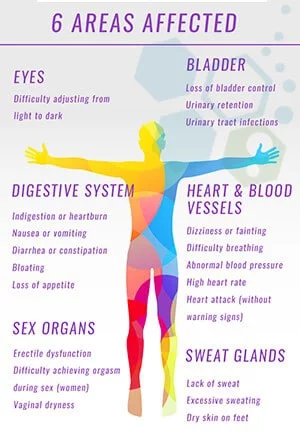
Damage to the Motor nerves is commonly seen as muscle weakness. Still, it may also produce uncontrolled muscle twitches (fasciculations), painful muscle cramps, and muscle atrophy with decreased reflexes similar to patients diagnosed with Ataxia, ALS, Motor Neuron Disease, Alzheimer’s, and Parkinson’s disease. A diagnosis of sensory nerve disease manifests itself as a variety of symptoms due to their broad range of uses/functions. Large sensory fibers in the myelin sheath identify vibrations and light touches. Any damage to the large sensory fibers will impair the sensation of touch. This type of nerve damage affects the hands and feet, causing them to feel like they are wearing gloves or stockings on the legs even though they are not wearing either. This type of damage makes men and women unable to coordinate complex muscle movements like running, fastening shirts, or maintaining proper balance when their eyes are closed.
Smaller sensory fibers are responsible for transmitting the sensation of temperature and pain. Patients diagnosed with damage to smaller sensory fibers may be unable to sense injury from an accident or that a wound has become infected. They also might be unable to detect the body’s signal of chest pain ( impending heart attack ). The Loss of our pain sensation is especially critical for patients with diabetic-induced neuropathy, resulting in a very high rate of limb amputations. Diabetic neuropathy is one of the most common types of peripheral nerve disease.[2]
Neuropathic-induced pain is a prevalent condition that seriously affects the emotional well-being and quality of life of a patient. Neuropathic pain also disrupts sleep, further compounding the physical burden of having sensory nerve damage. Neuropathic pain and allodynia are associated with hypersensitization of pain receptors in our skin, resulting in the feeling of severe pain from stimuli that would generally be painless. If left untreated, sensory neuropathy will lead to adverse changes in a patient’s hair, skin/joints, resulting in ligament damage, bone damage & osteoarthritis.
Autonomic nerve disease symptoms are also very diverse because our sympathetic & parasympathetic nerves are just about every organ in the human body. Commonly associated symptoms of autonomic nerve damage “AND” include the inability to perspire/sweat, usually resulting in heat intolerance, and can be identified using modern functional medical tests. Other symptoms include:
Symptoms of peripheral nerve damage can be experienced over a few days, months, or years and classified as acute or chronic. Acute neuropathies occur when symptoms appear unexpectedly, progress rapidly, and resolve very slowly. In chronic neuropathies, symptoms usually appear subtly and progress very slowly. Some patients may show signs of relief followed by a relapse in symptoms. For others, they reach a plateau where symptoms usually stay consistently the same for months or even years. Most cases of chronic peripheral neuropathy and Ankylosing spondylitis worsen over time and become extremely painful and debilitating, with some cases becoming terminal due to compounding medical issues such as diabetes or brain strokes. [3]
The Primary Causes of Neuropathy disease include:
The diagnosis of Peripheral neuropathy requires multiple tests to confirm, and it has many potential causes. A patient displaying symptoms should start with a complete physical exam, including blood tests. To confirm a diagnosis, further testing is usually needed. Tests include:
Treatment options for polyneuropathy depend on the underlying causes. For patients with type 1 diabetes or vitamin deficiencies, treatment often entails directly treating the underlying cause of their peripheral neuropathy diagnosis. Other measures, such as removing toxins or unfavorable environmental factors, can be used to treat mild conditions. Patients diagnosed with autoimmune neuropathy usually require much more aggressive therapies, including:
Current medications such as carbamazepine, Gabapentin, topiramate, Tricyclic antidepressant medications ( amitriptyline desipramine), Pain medications like ibuprofen or tramadol are used to mask the symptoms but do not do much as far as treatment of the underlying causes.
Expanded UC-MSC+ Stem cell therapy offers a promising avenue for addressing neuropathy in the legs and feet and provides the potential to reduce patient discomfort significantly. This condition, often characterized by pain, numbness, and impaired mobility due to nerve damage, can be effectively managed by harnessing the regenerative potential of mesenchymal stem cells (MSCs) or other advanced cell types. The treatment aims to repair damaged nerve tissues, reduce inflammation, and restore nerve function. Stem cells can be administered through targeted injections or intravenous delivery, where they release growth factors and signaling molecules to promote healing and regeneration. Clinical studies have shown that stem cell therapy can improve sensation, reduce discomfort, and enhance overall quality of life for patients with peripheral neuropathy caused by diabetes, autoimmune disorders, or injury. As research advances, stem cell treatments provide hope for those seeking innovative solutions to chronic nerve-related conditions.
Diabetic-induced neuropathy, or diabetic neuropathy, is a type of nerve damage that occurs as a complication of diabetes. High blood sugar levels over prolonged periods can injure nerves throughout the body, but diabetic neuropathy most often damages nerves in the legs and feet. The condition can manifest in various forms, including peripheral neuropathy, autonomic neuropathy, proximal neuropathy, and focal neuropathy, each affecting different body parts in distinct ways. Stem cell therapy offers a promising approach to treating diabetic neuropathy. This condition severely impacts the quality of life and urgently needs effective solutions. There are several types of diabetic neuropathy we can target, including:
Some benefits of isolated and expanded UC-MSC+ stem cell treatment include:
Mesenchymal Stem cell therapy (UC-MSC+) and paracrine signaling offer a unique and effective modern treatment option for patients suffering from neuropathy nerve damage and neuropathic pain. Unlike traditional treatments that respond poorly to opioid and OTC analgesics, our UC-MSC+ enhanced cell therapy uses a multi-layer combination therapy consisting of MSC+ hematopoietic
We treat neuropathic pain and create anti-inflammatory zones by releasing cytokines vital to nerve regeneration. Our cell injection protocol has been clinically proven to decrease proinflammatory (IL)-1β interleukin cytokine while increasing the anti-inflammatory (IL-10) cytokines in the lesioned nerve, along with a significant reduction in mechanical allodynia & thermal hyperalgesia. The consensus among our patients who had stem cell therapy for pain reduction was overwhelmingly beneficial and positive after the 1-2 week stem cell therapy. Our treatment is safe, with minimal side effects like drowsiness and weight gain.[4]
The cells used in the treatment are multipotent hematopoietic & undifferentiated cells taken from adult sources depending on the patient’s needs. The harvested cells are non-immunogenic and 100% matched to the patient.[5]
Get safe and permanent treatment for neuropathy at the Regeneration Centre. If you or a loved one are suffering from neuropathic pain or neuropathy. In that case, you/they are probably in unnecessary physical agony and should try to get out of the painful situation as early as possible. A clear diagnosis with recent test results is important in treating the condition with stem cells. Our request for a medical review can be made online. It will enable our medical team to better understand your needs before suggesting an effective protocol that will be used to treat this condition. Please note that the treatment requires travel to our stem cell hospital in Thailand for the estimated 2-week therapy course. Our pain management solutions help solve the root of the pain issues to improve the quality of life for our patients safely. If your daily activities are being affected by neuropathy, please get in touch with us today. Our medical professionals are experienced and trained in several pain conditions to ensure your condition improves as quickly as possible so you can get back to everyday life completely free of any discomfort or pain that comes with peripheral neuropathy.
[1] ^ Gerawarapong, Chinapat. 2015. Association of Peripheral Autonomic Neuropathy and Sympathetic Skin Response in the Patients with Diabetic Polyneuropathy: A Pilot Study in Thailand. Journal of the Medical Association of Thailand = Chotmaihet thangphaet, no. 12. https://www.ncbi.nlm.nih.gov/pubmed/27004308
[2] ^ Han, Ji Woong, Dabin Choi, Min Young Lee, Yang Hoon Huh, and Young-sup Yoon. 2015. Bone Marrow-Derived Mesenchymal Stem Cells Improve Diabetic Neuropathy by Direct Modulation of Both Angiogenesis and Myelination in Peripheral Nerves. Cell transplantation, no. 2 (May 13). doi:10.3727/096368915X688209. https://www.ncbi.nlm.nih.gov/pubmed/25975801
[3] ^ Kosachunhanun, Natapong, Siam Tongprasert, and Kittipan Rerkasem. 2012. Diabetic foot problems in tertiary care diabetic clinic in Thailand. The international journal of lower extremity wounds, no. 2 (May 2). doi:10.1177/1534734612446967. https://www.ncbi.nlm.nih.gov/pubmed/22553278
[4] ^ Nayagam, Bryony Ariya. 2012. Human stem cells ameliorate auditory evoked responses in a model of neuropathy. Stem cell research & therapy, no. 6 (November 8). doi:10.1186/scrt135. https://www.ncbi.nlm.nih.gov/pubmed/23134736
[5] ^ Puataweepong, Putipun, Mantana Dhanachai, Ake Hansasuta, Somjai Dangprasert, Chomporn Sitathanee, Thiti Swangsilpa, Patamintita Vitoonpanich, and Pornpan Yongvithisatid. 2015. Outcomes for Pituitary Adenoma Patients Treated with Linac- Based Stereotactic Radiosurgery and Radiotherapy: a Long Term Experience in Thailand. Asian Pacific journal of cancer prevention : APJCP, no. 13. https://www.ncbi.nlm.nih.gov/pubmed/26225666
